An introduction to the Sagehen Creek Field Station Outreach program.
00:01:00
Sunday, June 08, 2008


Predator reaction to animal coloration.
Sagehen researcher Jen Hunter studies predator response to animal coloration.
She creates taxidermy mounts of the same animals with different coloration, then puts them in the field with a camera trap to see how predators respond. Watch the video to see what happens.
08:51
She creates taxidermy mounts of the same animals with different coloration, then puts them in the field with a camera trap to see how predators respond. Watch the video to see what happens.
08:51
Saturday, May 17, 2008
Ant Ranchers.
 This is a short clip of ants farming aphids on a willow branch at Sagehen.
The ants protect & herd the aphids so they can "milk" them for their nutritious honeydew.
As bizarre as this idea of complex agricultural behavior seems in such a tiny-brained animal, several other species of ants are also farmers. For instance, Leaf-cutter Ants march those sail-like bits of leaves back to the nest where they chew them up for use as mushroom-growing medium. They don't eat the leaves, just the fungus.
Perhaps the scariest insect farmers are the Vampire Ants that occur a little north of Sagehen. Like all adult ants, the Vampires have a throat restriction that won't allow them to eat solid food. They hunt centipedes, but there is not enough juice to keep the adults nourished. So they feed the chunks of centipede to their larva--who lack the throat constriction--then puncture the babies' abdomens & drink their blood! The procedure is not fatal & all adult ants apparently bear scars from this bizarre adaptation.
00:19 [.MOV-548 KB]
Spawning native California Catostomus Tahoensis
 Here's a quick video we shot last summer of spawning native Tahoe Suckers.
What a bad name for such a cool fish! They really should call the Brook Trout "suckers" because they vacuum up the native fish eggs, whereas these guys just eat things like worms & mollusks.
01:33 [.MOV-4.4 MB]
Or watch on YouTube at lower resolution:
Friday, April 11, 2008
Sagehen Researcher discusses snow-water measurement.
 Sagehen researcher Chris Skalka of the U. of Vermont talks with Vermont Public Television about his work measuring snow-water equivalents using gamma radiation.
Here's the longer, more detailed video about remote sensing.
More info here.
Tuesday, February 05, 2008
Big storm cycle ends.

 A big winter storm cycle just ended.
Here's a clip of us mountaineering on the house to do "cornice control". Pretty tricky getting up the icicle without crampons, but jumping the "bergschrund" was easy!
See more pics from the storm at our blog.
Thursday, January 03, 2008
Orphaned bear cub released at Sagehen.
 The California Dept. of Fish & Game released another orphaned bear cub at Sagehen yesterday. Learn more about this cub's story & all of Sagehen's other bear research on our blog.
Read story & watch video on KGO-TV ABC7, San Francisco. Or download the video here:
PC [WMV-6.6MB | WMV-4.1MB]
Mac or iPod [MP4-7.2MB | MP4-5.1MB]
Flash [5.8MB]
There's another story & video on KOLO8-TV, Reno. Or download the video here:
PC [WMV-8MB | WMV-2.9MB]
Mac or iPod [MP4-8.2MB | MP4-3.1MB]
Flash [6.9MB]
Thursday, September 06, 2007
KGO-TV ABC 7 News revisits Sagehen, Part II
 The Bay Area's ABC affiliate, KGO-TV 7, visited Sagehen last year to report on the new Experimental Forest. Last month they returned for a follow-up.
You can read the second report of this series, ARC Program Helps Teenagers Thrive on the KGO-TV website & use the links below to watch the video.
00:04:26
Choose a video size & format below:
PC [WMV-6MB | WMV-16MB]
Mac or iPod [MP4-7.5MB | MP4-17.1MB]
Flash-11.5MB
Thursday, August 16, 2007
KGO-TV ABC 7 News revisits Sagehen
 Last year, KGO-TV--the Bay-area's ABC affiliate--ran a series of spots on the new Sagehen Experimental Forest & various research projects underway. This month, they returned for a follow-up. The first of the stories: Sierra's Experimental Forest Is A Scientist's Dream aired last night. You can watch the segment on the KGO-TV website or use the links below.
00:03:54
PC [WMV-5.2MB | WMV-14.9MB]
Mac or iPod [MP4-6.1MB | MP4-15.1MB]
Flash [10.3MB]
Saturday, June 09, 2007
Why are there so many butterflies around all of a sudden?
 UC Berkeley Ph.D. Candidate Ryan Hill explains the sudden appearance of butterflies in the Sierras every spring.
Copyright: 2007, UC Regents
04:30
Watch on YouTube [below], or download a higher-res version here: Mac [.mov-9.6MB]
Thursday, March 01, 2007
A Winter Visit to Sagehen.
 Sagehen Creek Field Station is a fully functional winter facility, even though a few things about access are a little different than in the summer season. Watch this video to get a tour of Sagehen in the winter.
Update, 2018: while this video is still quite explanatory and accurate, there have been some important changes at Sagehen.
The climate is shifting. Some years there is little or no snow at the station elevation. We do still get monster snow years, though, so you can't know for sure in advance.
The road is now kept open with a large snowcat, so there are very few days when it's not possible to drive to the facilities with a 2WD vehicle. High clearance helps, but is not mandatory. You should remain flexible in your scheduling, however! If you absolutely must get out in the morning after a storm for a flight, a meeting, or something else, you should plan ahead and leave your vehicle at the highway before the storm hits.
The Outdoor Meeting area in the Upper Camp is now covered with a permanent roof, so it's more useful in the shoulder seasons, or when it rains.
The Library is no longer a computer and GIS lab. It's just a meeting space, now that most people use and bring laptops.
We did add the 3 tall weather towers Jeff mentioned; we also remodeled and updated the Upper Bathhouse and many of the other spaces, but we did not build the Master Plan.
And we lost Buster and Nut, the cats :( Buster vanished, and Nut got old.
00:11:56
Tuesday, October 31, 2006
Television news coverage of Sagehen.
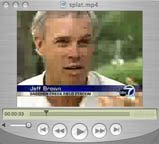
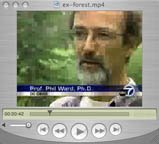
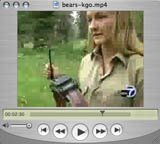 These videos are the KGO-TV segments about Sagehen that ran recently on the Bay Area ABC affiliate, apparently the largest broadcast television market in the country.
"The new Sagehen Experimental Forest." 03:33
Read article.
"Bear research at Sagehen." 03:26
Read article.
"SPLATs for Sierra forest fire management." 03:24
Read article.
Saturday, October 07, 2006
2006 A.R.C. Program slideshow
 See an animated slide show of pics from this summer's Adventure-Risk-Challenge literacy program.
Want more information about Sagehen's A.R.C. outreach program? Try our podcast or the A.R.C. web page where you'll also find examples of student writing & science projects.
00:08:18 [39 MB]
Friday, September 29, 2006
Conservation & Research Agreement signed for the North Fork of the American River
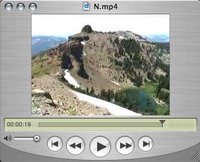 On September 26, 2006, a consortium of land owners & managers including: the North Fork Association, Chickering Partnership, USDA Forest Service Tahoe National Forest, US Forest Service Pacific Southwest Research Station & Regents of the University of California signed a Conservation and Research Agreement (with introductory letter) addressing future cooperative management of the approximately 19,670 acres of public & private lands in this watershed.
This agreement creates a common management vision for the headwaters of a unique watershed that contains many remarkable features, including a population of mountain yellow-legged frogs, diverse botany & the largest stand of California old growth forest outside of the National Park system.
More info about CSFRS.
See a brief video preview of the area. 00:17 -- for PC [.wmv-2.75M] | for Mac [.mp4-639K]
Monday, August 28, 2006
Sagehen Video thumbnail archive
This post automatically updates itself periodically to show thumbnails of every video on the Sagehen v-log, even the ones no longer visible on the main page. Click on a thumbnail to go to the video.
Or use this link to see a page with every Sagehen video we have, no matter whether it's hosted on our server, on YouTube, or on Vimeo.
Video archive by Mefeedia
Or use this link to see a page with every Sagehen video we have, no matter whether it's hosted on our server, on YouTube, or on Vimeo.
Video archive by Mefeedia
Sunday, August 27, 2006
Pirates of Sagehen Basin!
 Ant researcher, photographer & author Mark Moffett gets interested in Sagehen's slave-raiding ants. Why do the slaves put up with it? Same reason people do--because they don't know any better. They hatch out into the red ant nest & just assume that's where they belong.
Slave-making has evolved in ants nine separate times, so it apparently works.
Polyergus breviceps are obligate social parasites, meaning that they simply can't live without their slaves: they have lost the ability to dig tunnels, gather food, care for their babies. All they do is hang around, being taken care of until it's time to go out on another raid.
The video shows Polyergus breviceps [red ants] stealing brood [eggs & pupae] from nests of the host species, Formica argentea [black ants].
Many stages of a raid are shown: the nest before a raid with no red ants apparent [they don't work except to raid]; the initial red scout heading out, the red column advancing; winged red reproducers accompanying the column & mating along the way; black ants trying to block the entrances to their home; red ants unblocking the entrance, then taking brood from the target nest; racing back to the home nest where the black ants take over care & sometimes carry or drag the exhausted red ants.
The new black brood will hatch out & acquire the scent of the new home nest, then go right to work taking care of the red queen's eggs.
Meanwhile, the mated reproducers will lose their wings & attempt to find a black ant nest then kill its black queen, taking over egg laying duties & converting the nest to a red ant nest with black slaves. There will be no more black ant eggs produced in these attacked nests.
A little creepy, eh?
Download this short ants reel here.
Thursday, August 17, 2006
Sagehen Summer Speaker Series #10: Plant Communication
 7-29-06: Professor Rick Karban of UC Davis keeps the crowd enrapt with discussion of his controversial research showing that plants exchange information with each other in response to predators (but you don't have to call it "communication" if that idea bothers you!).
00:49:40 [34.5 MB] or watch below...
Plant Communication from F. Felix on Vimeo.
Thursday, August 10, 2006
Sagehen Experimental Forest Dedication Ceremony, June 24, 2006
 The Sagehen Experimental Forest Dedication ceremony was held at Sagehen Creek Field Station on June 24, 2006. A number of important people from the Forest Service and UC Berkeley spoke at this historic occasion, making a number of interesting observations about the purpose and potential of the Sagehen Experimental Forest. Watch.
00:52:40 [62.8 MB]
Read about the Sagehen Experimental Forest dedication here.
Friday, July 28, 2006
Bear research revs up in the Sagehen Experimental Forest.
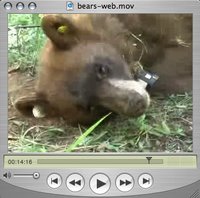
California Dept. of Fish & Game began a black bear project in the basin this season. Researcher Jennapher Miller and assistants Deniz Kuzio, Caitlin Kroeger, Harry Reynolds, and Charlie Robbins have been scouting out the bear habitat and putting out lasso traps in likely areas. Yesterday, they finally caught one--very exciting!
You can read the abstract for this project on our Calendar page.
Subscribe to:
Posts (Atom)